Revolutionizing Finance: How Generative AI is Redefining Banking Services and Risk Management
In today’s fast-paced financial world, generative artificial intelligence (AI) is no longer just a futuristic concept — it’s actively reshaping how banks operate, manage risk, and interact with customers. From automating complex workflows to providing hyper-personalized services, generative AI is enabling banks to operate faster, smarter, and more securely than ever before. For institutions slow to adapt, the risk isn’t just missing efficiency gains; it’s losing relevance in an increasingly competitive landscape.

Generative AI: A Game-Changer for Banking
Generative AI, powered by large language models and other advanced machine learning algorithms, can generate human-like insights, automate decision-making, and produce actionable data interpretations. Unlike traditional rule-based systems, generative AI adapts to patterns and learns from vast datasets — a crucial capability in banking where market conditions, customer behavior, and regulatory requirements change constantly.
Banks are leveraging this technology in ways that weren’t possible even a few years ago: drafting reports in seconds, detecting fraud in real-time, and offering customers guidance that feels genuinely tailored to them. It’s not just automation; it’s a smarter form of intelligence that augments human decision-making.
Transforming Core Banking Services
1. 24/7 Intelligent Customer Support
Customers today expect instant responses and personalized guidance, and generative AI-powered chatbots deliver just that. These virtual assistants understand nuanced queries, provide contextual advice, and even guide users through complex financial processes like loan applications or international transfers.
The subtle impact? Banks can reduce customer service costs while building trust. A customer who receives accurate, timely, and human-like support is more likely to stay loyal — something traditional call centers often struggle to achieve.
2. Automating Complex Workflows
Banks process enormous volumes of documentation — from contracts to compliance filings. Generative AI can summarize documents, extract actionable insights, and even draft responses, dramatically reducing manual work.
For instance, AI can automatically scan a new regulation, determine which banking processes are affected, and produce a summary for compliance teams. This not only accelerates workflows but also allows human experts to focus on strategic decisions rather than repetitive tasks.
3. Personalized Financial Experiences
In the past, hyper-personalized financial advice was limited to high-net-worth clients. Generative AI changes the game by analyzing individual customer data to offer tailored recommendations for investments, savings, or loan options.
This personalization isn’t superficial upselling. It subtly guides customers toward smarter financial decisions while making them feel understood. Over time, this builds a deeper, trust-based relationship — a critical competitive edge in an era where digital experiences drive customer loyalty.
Redefining Risk Management
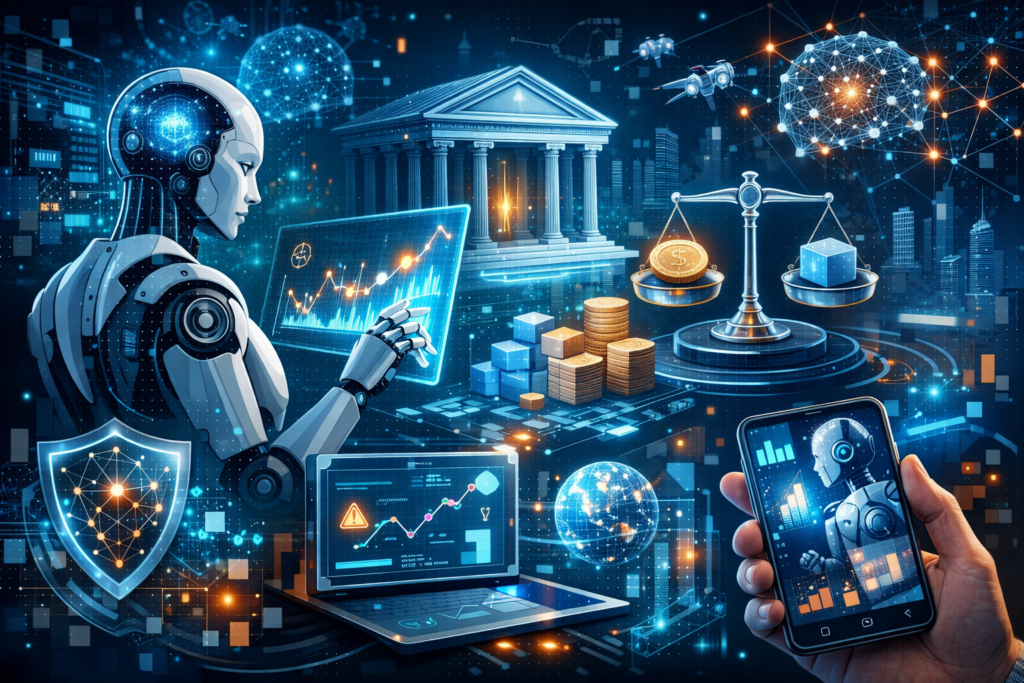
Financial institutions face multifaceted risk: credit risk, market volatility, fraud, and regulatory compliance. Generative AI strengthens risk systems in several transformative ways.
1. Advanced Fraud Detection
Fraudsters evolve quickly, often outpacing traditional, static detection systems. Generative AI models analyze patterns in massive transaction datasets in real-time, detecting subtle anomalies that could indicate fraudulent activity.
The result: risk teams shift from reactive detection to proactive prevention, catching threats before they escalate. For example, AI can flag irregular spending patterns on a credit card even before a human analyst would notice.
2. Real-Time Risk Assessment
Generative AI can simulate complex financial scenarios, incorporating historical data, market signals, and emerging trends. This enables banks to forecast potential risks across portfolios — from loans to investments — with a level of speed and accuracy traditional models cannot match.
This predictive capability gives executives a sharper lens on potential vulnerabilities, allowing them to make informed decisions in dynamic markets.
3. Smarter Compliance and Regulatory Reporting
Compliance is a notoriously time-consuming aspect of banking. Generative AI can scan regulations, interpret their implications, and draft reports, ensuring accuracy while reducing human error.
Moreover, AI-driven compliance tools maintain detailed audit trails, reinforcing trust with regulators and protecting institutions from costly penalties.
Case Studies and Real-World Adoption
Leading financial institutions are already reaping the benefits:
- HSBC has partnered with AI startups to integrate generative AI into fraud detection, credit analysis, and multilingual client communications, enhancing both internal efficiency and customer experience.
- Morgan Stanley is developing bespoke AI tools for portfolio analysis and client engagement, demonstrating that successful implementation requires both technology and strategic alignment.
- Fintech challengers often deploy AI faster than traditional banks, forcing incumbents to innovate or risk losing market share.
The lesson is clear: generative AI isn’t optional for forward-thinking banks; it’s a competitive necessity.
Addressing Challenges and Risks
Despite its promise, generative AI isn’t a silver bullet. Implementing it responsibly requires careful attention to:
- Bias and Fairness: Models trained on historical data can unintentionally perpetuate discrimination unless rigorously audited.
- Data Privacy and Security: Financial data is highly sensitive, necessitating strict protocols for training and deployment.
- Explainability: Decisions influenced by AI must be interpretable, especially when they affect loans, investments, or compliance actions.
Acknowledging these challenges isn’t pessimistic — it’s essential for creating a sustainable AI-driven financial ecosystem.
The Future of AI in Banking
Looking ahead, several trends are shaping the next era of AI-powered finance:
- Integrated Workflows: AI will be embedded deeper into banking systems, not just as add-on tools.
- Synthetic Data for Simulation: AI-generated data will allow stress testing and scenario planning without compromising customer privacy.
- Adaptive Governance: Banks will refine AI governance to comply with evolving regulations while preserving innovation.
- Human-AI Collaboration: The future isn’t humans vs. AI — it’s humans augmented by AI, leveraging efficiency without losing judgment.
Banks that embrace these trends will position themselves as leaders in the AI-driven financial landscape.
Conclusion
Generative AI is not a fleeting trend — it is redefining the very fabric of banking services and risk management. Institutions that adopt it gain advantages in operational efficiency, customer experience, and predictive insights, while those that delay risk falling behind.
For users, investors, and professionals, one thing is certain: the future of finance is intelligent, adaptive, and increasingly powered by AI. And for banks, integrating these technologies effectively will determine which institutions thrive and which merely survive.