Institutional Finance Meets DeFi: How “DeFi 2.0” Is Making Its Way into Big‑Wallet Portfolios
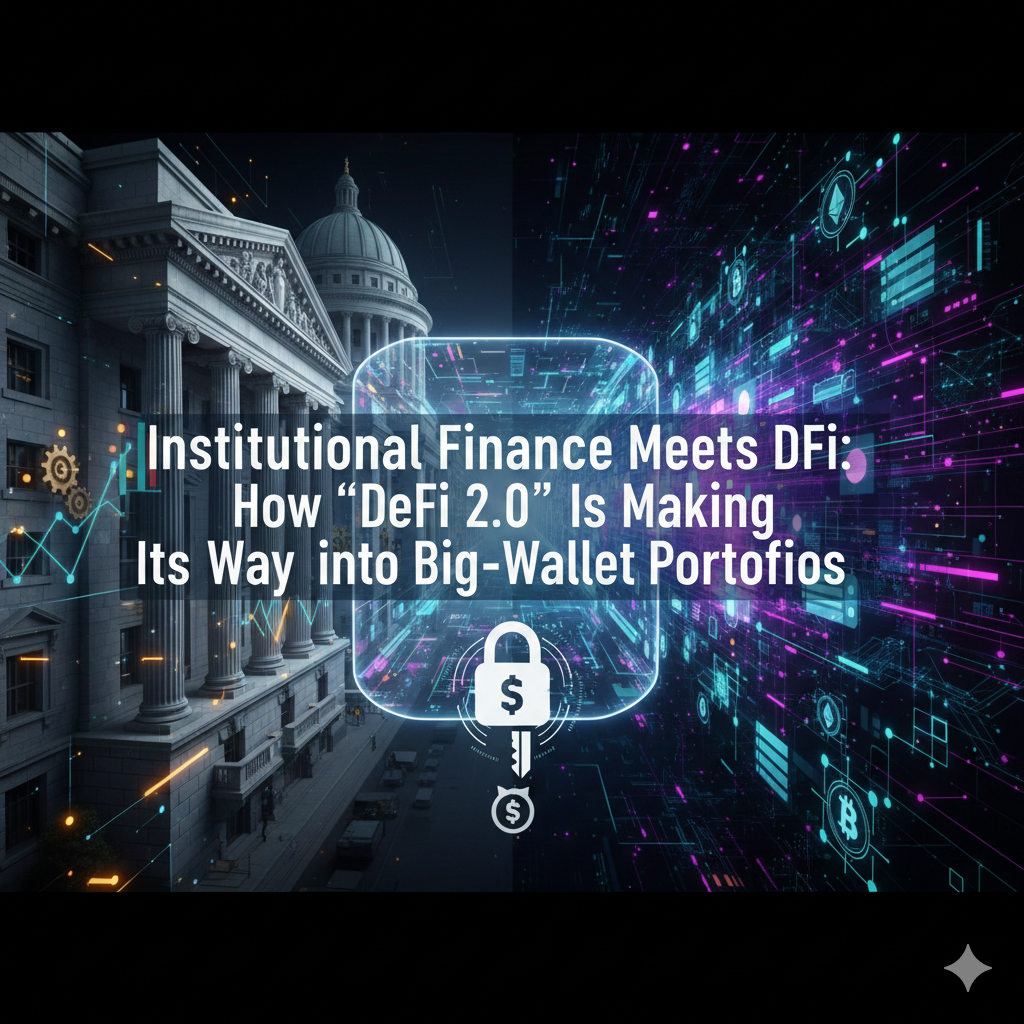
The financial landscape is evolving. Once dominated by intermediaries, banks, and slow settlement cycles, it now finds itself intersecting with decentralized finance (DeFi). For years, DeFi was seen as a playground for crypto enthusiasts and retail investors, but DeFi 2.0 is changing the game. Institutional investors — hedge funds, asset managers, and large financial institutions — are starting to explore its potential for inclusion in big-wallet portfolios.
DeFi 2.0 is not just an upgrade; it’s a reimagination of what decentralized finance can do. It addresses past limitations like unsustainable liquidity incentives, fragmented protocols, and security vulnerabilities. More importantly, it introduces sophisticated tools, improved governance, and real-world asset tokenization — elements that resonate strongly with institutional needs.

Understanding DeFi 2.0 and Its Appeal to Institutions
DeFi 2.0 builds on the foundations of early DeFi but fixes key inefficiencies. Where the first generation relied on temporary liquidity providers and often volatile yield farming, DeFi 2.0 emphasizes:
- Protocol-Owned Liquidity: Institutions favor predictable returns. DeFi 2.0 protocols that own their liquidity reduce reliance on external contributors, enhancing stability.
- Cross-Chain Interoperability: Big wallets often need access across multiple blockchains. DeFi 2.0’s cross-chain solutions enable seamless capital flow, opening new markets without added friction.
- Layer-2 Scaling Solutions: Faster transactions at lower fees mean operational efficiency for large-scale portfolios.
- Enhanced Security & Governance: Regular audits, DAO governance, and advanced risk protocols increase confidence among institutions.
These features collectively align DeFi 2.0 with the risk tolerance, compliance expectations, and operational needs of institutional players, bridging the gap between traditional finance (TradFi) and decentralized ecosystems.
Bridging Traditional Finance and DeFi
Tokenization is a key bridge between TradFi and DeFi. Real-world assets — from bonds to equities to money market funds — can now be represented as blockchain tokens. This brings transparency, automation, and global liquidity while remaining compliant with regulations.
Institutions are already experimenting with:
- Tokenized Money Market Funds: These offer blockchain-level transparency while maintaining compliance with regulatory standards.
- Digital Securities Platforms: Platforms like Securitize allow institutions to issue, trade, and manage securities on-chain, streamlining operations and reducing manual reconciliation.
The convergence is pragmatic. Institutions are not abandoning traditional strategies; they are augmenting them with hybrid models that combine stability with blockchain efficiency.
Why Institutions Are Embracing DeFi 2.0
While retail investors may focus on yield, institutions are drawn to DeFi 2.0 for several reasons:
1. Operational Efficiency
Automation via smart contracts reduces reliance on intermediaries. Settlement cycles that once took days are now almost instantaneous. Cost savings and improved execution speed are significant for large portfolios.
2. Global Liquidity Pools
DeFi 2.0 taps into borderless liquidity. Institutional participants can deploy capital efficiently across multiple markets, accessing opportunities that were previously inaccessible.
3. Advanced Risk Management Tools
On-chain derivatives, decentralized hedging mechanisms, and synthetic instruments allow institutions to manage volatility, interest rate risk, and currency exposure. Transparency in these tools surpasses many traditional instruments.
4. Auditability & Transparency
Every transaction is recorded on-chain, creating a complete, auditable trail. This strengthens regulatory compliance, internal reporting, and investor confidence.
Institutional Engagement in Practice
Theoretical appeal is one thing; real-world adoption tells a different story. Some practical examples include:
- Tokenized Funds: Major banks are creating blockchain-based versions of traditional funds. These products offer predictable yields and automated governance, a key draw for institutional investors.
- Hybrid DeFi-TradFi Models: Some funds are combining tokenized assets with traditional hedging strategies, enabling institutions to diversify risk while exploring new yield sources.
- Innovative Incentive Models: Protocols offering fee-sharing or liquid restaking rewards are attracting institutional liquidity while maintaining sustainability.
According to recent reports, the total value locked (TVL) in institutional-grade DeFi protocols has surpassed $100 billion, reflecting both growing adoption and renewed confidence.
Trends Driving Institutional Adoption in 2024
Several emerging trends are accelerating DeFi 2.0 adoption among institutions:
- Liquid Restaking: Enables institutions to earn yield on staked assets while maintaining flexibility.
- Cross-Chain Solutions: Reduces fragmentation, allowing capital to flow seamlessly across Ethereum, Solana, Avalanche, and other networks.
- Tokenized Real-World Assets: Bridges the gap between physical markets and DeFi, giving institutions exposure without leaving regulatory compliance behind.
- Sustainability of Yields: DeFi 2.0 focuses on long-term, protocol-owned liquidity models, addressing criticisms of the early DeFi boom.
These trends indicate that DeFi 2.0 is not a passing fad. Rather, it’s evolving into a robust infrastructure that meets institutional standards.

Risks to Consider
No financial innovation is without risk. For institutions, the main considerations include:
- Regulatory Uncertainty: Laws regarding digital assets are still evolving. Institutions need frameworks that allow agile adaptation.
- Technical Vulnerabilities: Smart contract exploits, cross-chain bridge risks, and protocol bugs remain concerns. Rigorous audits are essential.
- Market Volatility: Crypto markets are inherently more volatile than traditional asset classes, demanding strong risk management strategies.
Savvy institutions mitigate these risks with diversified exposure, robust due diligence, and close collaboration with compliance experts.
The Future of Institutional Portfolios
Institutional portfolios are evolving. Just as equities and bonds once seemed complex, DeFi 2.0 is becoming a core part of diversified institutional strategies. Hybrid models, tokenized treasuries, and blockchain-native derivatives are no longer experimental but increasingly standard.
For investors, the message is clear: DeFi 2.0 offers efficiency, transparency, and innovation without abandoning regulatory and risk frameworks. Those who integrate it carefully can achieve portfolio diversification, enhanced yields, and exposure to a growing digital asset ecosystem.
Conclusion
DeFi 2.0 is reshaping the investment landscape. Institutional players are entering not just for yield but for operational efficiency, transparency, and governance innovations. The fusion of TradFi rigor with blockchain flexibility is creating a new paradigm in portfolio management.
For financial websites and content creators, covering this intersection is both timely and valuable. As institutions continue to experiment with and adopt DeFi 2.0, high-quality, authoritative content will attract traffic, earn backlinks, and meet Google Adsense’s quality standards.
With the right strategy, this content positions your website as a trusted resource in finance, technology, and decentralized innovation — exactly where large wallets, curious investors, and tech-savvy audiences are looking.