Mobile Operating Systems in the AI Race: Who’s Winning?
Artificial intelligence is no longer a side feature in mobile operating systems—it has become the core battlefield. What started with simple voice assistants and basic automation has evolved into on-device large language models, real-time image generation, contextual personal assistants, and deep system-level intelligence. Today, the question is no longer whether mobile operating systems will be AI-driven, but which platform is executing that vision best.
From a financial and technological perspective, the AI race among mobile operating systems is shaping entire ecosystems, influencing hardware sales, developer adoption, advertising models, and long-term platform dominance. When you look closely, this competition is less about flashy demos and more about infrastructure, scale, and strategic patience.
So, when we compare mobile operating systems in the AI race, who is actually winning?
Why AI Has Become the Defining Factor for Mobile Operating Systems
Mobile operating systems sit at a unique intersection: massive user bases, constant data flow, and tight integration with hardware. AI thrives in this environment. The OS that best embeds AI into everyday interactions gains not just user loyalty, but behavioral dependency.
What makes this race especially interesting is that AI success on mobile is not measured by raw model size, but by:
- How seamlessly AI integrates into daily tasks
- How efficiently it runs on-device
- How well it respects privacy while remaining useful
- How easily developers can build on top of it
This is where the real differences between platforms start to surface.

Android: Scale, Infrastructure, and Quiet Dominance
Android often gets framed as a fragmented ecosystem, but in the AI race, fragmentation has turned into an advantage. With billions of active devices worldwide, Android provides something no competitor can replicate: scale at every data and deployment layer.
Google’s approach to AI in Android is not always loud, but it is systematic. AI features are embedded deep into the OS:
- Predictive text and contextual replies that actually learn over time
- AI-powered call screening and spam detection
- Real-time translation and transcription baked into system apps
- On-device AI models optimized through Tensor and Snapdragon NPUs
What stands out is how Android’s AI feels invisible. Instead of forcing users to “use AI,” it quietly improves outcomes—better photos, smarter notifications, less friction. From a long-term value standpoint, this is exactly how mass adoption happens.
Another underestimated advantage is Google’s vertical integration across AI research, cloud infrastructure, and mobile deployment. Android benefits directly from advances in Google’s foundational models, often faster than users realize.
iOS: Precision, Privacy, and Controlled Intelligence
Apple’s strategy in the mobile AI race is fundamentally different. Rather than chasing scale, iOS focuses on control, optimization, and user trust. Apple rarely ships AI features unless they meet strict standards for performance and privacy, which can make progress feel slower—but also more deliberate.
Where iOS excels is on-device intelligence:
- Face ID and biometric security remain industry benchmarks
- Image and video processing powered by Neural Engine hardware
- Context-aware suggestions that prioritize privacy-first computation
- Increasing emphasis on private, offline AI processing
Apple’s strength lies in its ability to align hardware, software, and silicon. When AI features do arrive on iOS, they tend to be deeply optimized and energy-efficient, which matters more on mobile than raw model complexity.
There is also a financial angle here: Apple doesn’t need to monetize AI through ads or data. This allows iOS to prioritize user experience over engagement metrics—a subtle but important competitive advantage.
That said, Apple’s closed ecosystem can slow external innovation. Developers often have fewer degrees of freedom compared to Android, which may limit how fast third-party AI applications evolve on iOS.
Windows on Mobile: A Strategic Missed Opportunity
Although Windows once aimed to compete in mobile operating systems, its current relevance in this specific AI race is minimal. Microsoft has chosen a different battlefield: AI as a service layer across devices, rather than a standalone mobile OS.
This shift makes sense financially and strategically, but it also means Windows is no longer a direct contender in mobile AI dominance. Instead, Microsoft’s influence appears indirectly—through AI integrations in apps, cloud services, and cross-platform tools.
In other words, Windows is shaping mobile AI from the outside, not from the OS level.
The Real Differentiator: On-Device AI vs Cloud AI
One of the most critical dimensions in the mobile operating systems AI comparison is where intelligence actually runs.
- Cloud-based AI offers power and flexibility but raises latency and privacy concerns
- On-device AI enables speed, offline functionality, and better trust
Android currently leads in hybrid deployment—fluidly combining cloud and on-device intelligence. iOS, on the other hand, leans heavily into on-device processing, betting that privacy-centric AI will win long term.
From a user standpoint, both strategies make sense. But from a market perspective, hybrid models often scale faster, especially in emerging markets where connectivity is inconsistent.
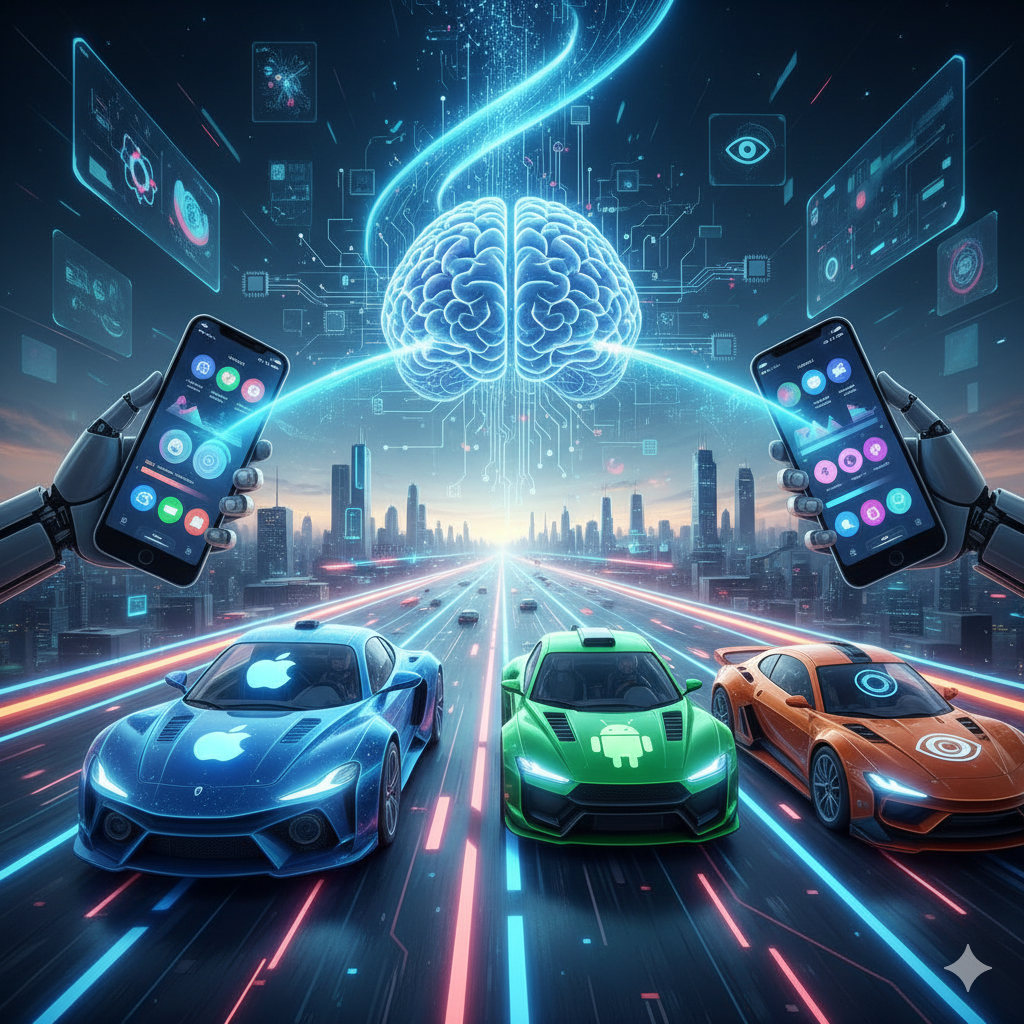
Developer Ecosystems: Where Innovation Accelerates
AI progress in mobile operating systems is amplified—or constrained—by developers.
Android’s open ecosystem allows:
- Faster experimentation with AI-driven apps
- Deeper system-level access for automation and intelligence
- Wider hardware diversity for AI optimization
iOS counters this with:
- Higher average app quality
- Better monetization opportunities
- More consistent performance across devices
Interestingly, many cutting-edge AI apps appear on Android first, while refined, consumer-friendly versions often peak on iOS later. This pattern suggests that Android is where AI ideas are born, and iOS is where they mature.
Financial Implications of the Mobile AI Race
From an investment and monetization perspective, mobile AI is not just a feature—it is a growth engine.
- AI-driven personalization increases ad efficiency
- Smarter OS-level intelligence reduces churn
- Hardware optimized for AI commands higher margins
- AI ecosystems create lock-in effects that last years
Android’s ad-driven model benefits immediately from better AI targeting and engagement. Apple, meanwhile, strengthens its premium positioning, turning AI into a silent justification for higher device prices.
Both approaches are profitable—but they reward different types of patience.
So, Who’s Winning the Mobile Operating Systems AI Race?
If “winning” means largest AI footprint today, Android clearly leads. Its scale, integration with Google’s AI infrastructure, and rapid deployment give it an undeniable edge.
If “winning” means long-term trust, efficiency, and user loyalty, iOS is playing a slower but potentially more defensible game.
The reality is that this is not a zero-sum race. The mobile AI future is likely to be shaped by Android’s breadth and Apple’s depth. Each platform is winning in the way that best aligns with its business model—and that alignment matters more than short-term feature parity.
What is clear is this: mobile operating systems are no longer just software layers. They are becoming intelligent financial assets, and the AI decisions made today will define who controls user attention, data flows, and digital value for the next decade.
In that sense, the real winners may not be decided by a single breakthrough—but by who integrates AI so naturally that users stop noticing it altogether.